Liquid Rocket Fuel Tanks
September 2025 - Present
OBJECTIVE:
Size, design, and validate fuel tanks to be used on a liquid bi-propellant engine rocket for Northeastern University's AerospaceNU club.
IMPACT:
Established a validated tank and pressurization architecture that meets structural safety requirements and supports integration with a full flight vehicle design. The analysis and sizing work created a foundation the team is carrying forward into fabrication, testing, and future vehicle design.


PROCESS:
The first and most challenging part of this design process was determining the required volume of pressurant to maintain sufficient tank pressure throughout flight. The liquid oxygen (LOX) and kerosene fuel tanks will be maintained at a pressure of 750 PSI for the duration of the flight, while the upstream pressurant tank has a varying pressure. To determine the volume required, I split the problem into two states: pre-burn and post-burn, illustrated on the left. I used isentropic relations, the ideal gas model, and continuity to develop an expression relating the initial and final upstream pressure to the volume of the pressurant tank.


After developing an expression relating the required pressurant volume to the initial and final states, I created a parameterized spreadsheet to continuously update the required volume as changes were made to the LOX and kerosene mass flow rates.
The resulting required volume and pressure guided me in selecting a composite - overwrapped pressure vessel (COPV) to function as our pressurant tank, shown on the right.

RESULTS AND NEXT STEPS: With the preliminary tank design completed, I am moving on to a more detailed stress analysis in collaboration with my teammates to validate the tank design before sending the kerosene and LOX tanks out for fabrication.
So far I have developed my skills in mechanical design, stress analysis, thermodynamics, and CAD. I will be machining the sealing plates for the tanks myself, so I will further develop my own fabrication skills and understanding of design for manufacturing.

With the COPV selected, I moved on to the design of the LOX and kerosene tanks. For both tanks, I selected Aluminum 6061-T6 for its light weight and adequate strength properties under cryogenic temperatures. I then began the mechanical design of the tanks, starting with pressure vessel calculations based on thin - walled pressure vessel equations. I also included the shear stress at the flanges on both ends, accounting for the stress concentration where the flange meets the tank body.
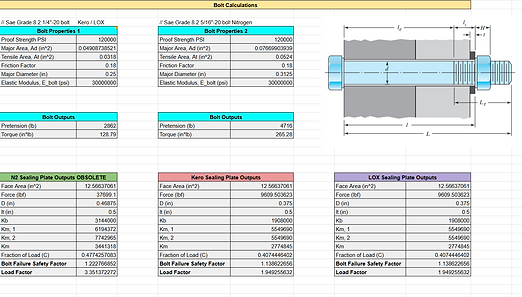
I then moved on to a bolt analysis, using principles from Shigley's Mechanical Engineering Design to determine safety factors against bolt failure, loosening, and minimum gasket pressure. The parameterized tool I created to determine required bolts and safety factors is shown below.